
Decks built for the high plains
Deck Builders in Aurora, CO
Composite and wood decks on deep footings, with joists and beams that carry winter snow and boards chosen for thin-air sun and hail.
- Free on-site estimates
- Written, itemized quotes
- Footings set below Aurora's 36-inch frost line
Building Decks That Hold Up East of Denver
Choosing deck builders in Aurora means choosing someone who understands what this city does to outdoor structures. The city's official elevation sign reads 5,471 feet, and the land rises nearly 1,000 feet from the low spot along Sand Creek in the northwest to the Douglas County line in the south. The climate is semi-arid, with roughly 18 inches of precipitation a year, snow that usually arrives in late October and can linger into late April, and hail that is common in spring and summer. A deck here freezes and thaws, carries snow, bakes in thin-air sunshine and takes the occasional hailstorm, often all in the same year.
What the city's design numbers mean for your deck
The City of Aurora Building Division publishes the loads it expects structures to be designed for. Its criteria list a minimum foundation depth of 36 inches for frost, a ground snow load of 34 pounds per square foot, a roof snow load of 30 psf (20 psf for pergolas), and a design wind speed of 115 mph for ordinary homes. The city's homeowner handbook lists a 40 psf load for decks. In practice that means footings that go deeper than many people expect, joists and beams sized for real weight, and posts that are anchored rather than set on blocks. Shallow concrete can be lifted by freezing ground, and a deck that was level in October may tilt by April.
When Aurora requires a deck permit
Under Aurora's handbook, any deck whose surface is over 30 inches off the ground always needs a permit, plan submittal and a framing inspection, and a lower deck needs the same if it is attached to the house. The plot plan you submit is checked for setbacks from property lines and for utility easements. A permit expires if work does not begin within six months or is not finished within a year. We prepare the drawings and plot plan, submit them, and schedule the inspections. Aurora builds to the 2021 International Residential Code with local amendments, so we design to that edition.
Sun, hail and the materials question
UV exposure rises with altitude; the EPA estimates roughly a 2 percent gain per thousand feet of elevation, which works out to roughly 10 to 11 percent more than sea level at Aurora's elevation. That extra sun fades stain and dries out wood faster. Hail is the other factor. Colorado State University's climate center data show severe hail days peaking in early to mid-June, with activity starting in late April and tapering off by mid-August. Capped composite holds color without stain; wood is cheaper on day one and asks for periodic refinishing. We will walk through both with you and explain where each makes sense.
Soil and drainage under the deck
The Colorado Geological Survey calls expansive soils the state's most significant geologic hazard, because clay that swells when wet and shrinks when dry can lift and crack slabs and lightly loaded foundations. The survey notes that these clays are common on the plains and that most of Colorado's homes are in areas with potentially expansive clay. Deck footings that reach below the active zone, plus grading that sends water away from posts and the house, help keep a deck stable. If we see signs of swelling soil or standing water at your site, we will point them out before you commit to a design.
Steps in a typical new build
- A visit to take measurements, read the slope of the yard and study where the deck meets the house
- A design with decking, railing and stair options, and a written, itemized quote
- Permit drawings, plot plan and submittal to the building department when needed
- HOA architectural request materials, if your community requires approval
- Footing holes dug and poured below the frost line, then framing with flashed, bolted ledger connections
- Decking, railings and stairs installed to the manufacturer's instructions
- City inspections passed and a final walk-through with you
Why Homeowners Call Aurora Pro Deck Builders
Designed to Aurora's numbers
Footings at least 36 inches deep and framing sized for the city's published snow and deck loads.
Permits handled
We prepare drawings and the plot plan, submit them, and schedule the framing and final inspections.
Materials matched to the climate
We explain how composite and wood each handle high-altitude sun, hail and freeze-thaw before you choose.
A written, itemized price
Your quote lists the size, materials, footings, railings, permit work and cost. Changes are approved in writing.
Where We Work
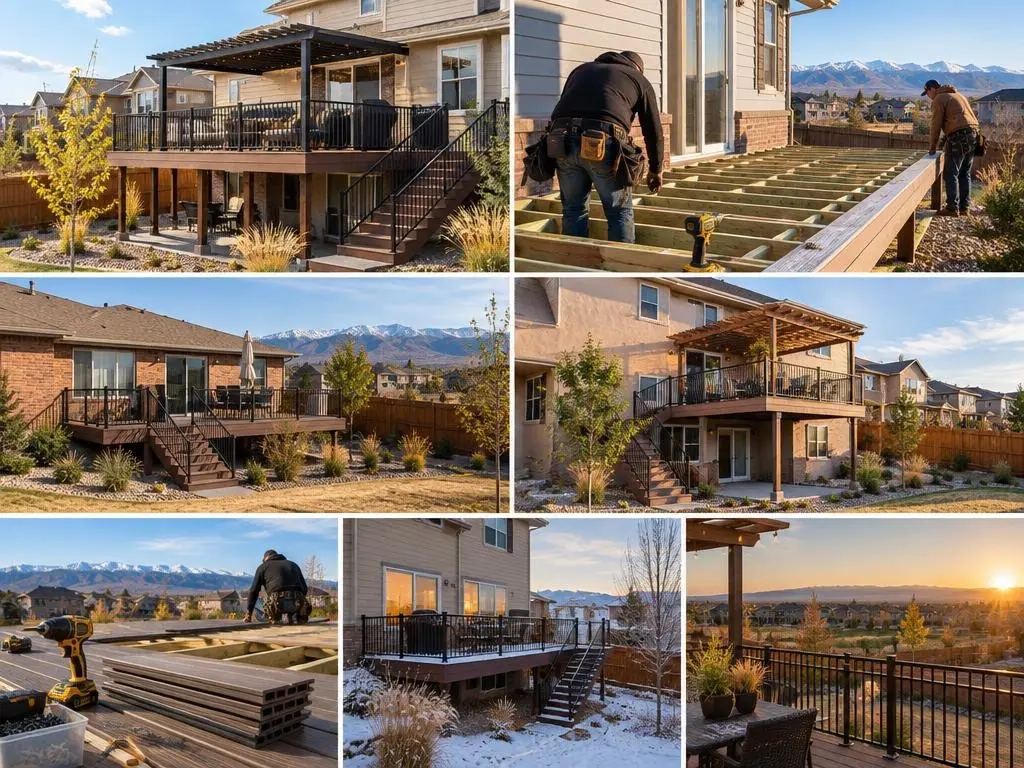
We work throughout Aurora, from older neighborhoods near Colfax and the former Fitzsimons and Lowry areas to newer subdivisions such as Saddle Rock, Tallyn's Reach, Murphy Creek and the communities around Southlands. Aurora spreads across three counties (Arapahoe, Adams and Douglas), and the same building division covers all of it. We also build in nearby communities across the east and south Denver metro, including Denver, Centennial, Parker, Englewood, Greenwood Village, Littleton, Lone Tree, Highlands Ranch, Castle Rock, Commerce City, Brighton, Thornton, Northglenn, Westminster, Arvada, Lakewood and Elizabeth. Each city and county runs its own permit office and may set different thresholds, fees and submittal rules, so we confirm the requirements for your address before drawings are prepared. Many neighborhoods also have HOA covenants that call for architectural approval, which we account for in the schedule.
- Deck Builders in Aurora, CO
- Deck Builders in Centennial, CO
- Deck Builders in Parker, CO
- Deck Builders in Denver, CO
- Deck Builders in Englewood, CO
- Deck Builders in Greenwood Village, CO
- Deck Builders in Littleton, CO
- Deck Builders in Highlands Ranch, CO
- Deck Builders in Lone Tree, CO
- Deck Builders in Castle Rock, CO
- Deck Builders in Commerce City, CO
- Deck Builders in Brighton, CO
- Deck Builders in Thornton, CO
- Deck Builders in Northglenn, CO
- Deck Builders in Westminster, CO
- Deck Builders in Arvada, CO
- Deck Builders in Lakewood, CO
- Deck Builders in Elizabeth, CO
Our Deck Services
From new composite and wood decks to repairs, covers, railings and refinishing, each service is planned around Aurora's frost line, snow loads and sun.
Composite Deck Building
Capped composite and PVC decks on framing sized for Aurora's snow loads, with no staining to keep up with.
Learn more →Wood Deck Building
Pressure-treated pine and cedar decks framed and finished for dry air, freeze-thaw and intense sun.
Learn more →Deck Repair & Replacement
Honest inspection of boards, framing, footings and ledgers, then a repair or full replacement plan in writing.
Learn more →Covered Decks & Pergolas
Pergolas and solid-roof deck covers framed for Aurora's snow and wind numbers, with shade where you need it.
Learn more →Deck Railings & Stairs
Guards in aluminum, cable, glass, composite or wood, and steps with graspable rails and a light at the top.
Learn more →Deck Staining & Sealing
Cleaning, prep and penetrating stain for wood decks that take a beating from high-altitude sun and dry air.
Learn more →
Common Questions
What is the average cost of a deck in Colorado?
The national cost guides we used do not break out a Colorado-only figure, so national data is the starting point. Angi (September 2026) lists $8,321 as the U.S. average, with a typical range of $4,339 to $12,653. Deeper frost footings, elevated walkout decks and composite boards push Aurora projects toward the higher end. Your written estimate sets the price.
How much should a 12x24 deck cost?
Angi lists a 12x24 deck (288 square feet) at about $11,520 to $17,280 nationally. Pressure-treated wood lands near the low end and capped composite or PVC near the high end. Height matters too: a deck off a walkout basement needs taller posts, more bracing and longer stairs than one a step above the patio.
Do deck builders charge by the hour?
Most deck builders price a new deck by the job, not by the hour. Published hourly figures vary: Forbes Home cites $35 to $75 an hour for installers' labor, and Angi lists $50 to $100 an hour for repair work. We give a fixed written price for the scope you approve.
What is the best deck material for a home in Colorado?
It depends on budget and how much upkeep you want. Capped composite holds its color better in strong sun and does not need staining, which suits Aurora's high UV. Pressure-treated pine and cedar cost less to build but need washing and restaining on a regular cycle. We show samples of each at the estimate.
Does Aurora require a permit for a new deck?
Usually. The City of Aurora's homeowner handbook requires a permit and framing inspection whenever the deck surface is over 30 inches high, and lower decks need one if they attach to the house. A low, freestanding deck may not, but setbacks and easements still apply. Confirm with the Aurora Building Division; we handle the application when one is required.
What frost depth applies to deck footings in Aurora?
The City of Aurora's engineering design criteria and homeowner handbook both list a 36-inch frost depth. Footings that stop above that line can be pushed up by freezing soil. Footing size also depends on the load each post carries and the soil, so we size them for each design.
What time of year works for a deck build in Aurora?
Spring through fall is the usual building season, and getting on the calendar early helps if your HOA needs to review the plans. Footings can be poured in cold weather if the ground is not frozen and the concrete is protected, and composite can be installed in cool weather with proper gapping. Snow and frozen ground can push dates back in winter.
Get a Deck Estimate in Aurora
Free on-site estimates for new decks, repairs, covers and refinishing in Aurora and nearby.